function printDiv(eh)
{
var divToPrint=document.getElementById(eh);
var newWin=window.open('','Print-Window');
newWin.document.open();
newWin.document.write('<html><body onload="window.print()">'+divToPrint.innerHTML+'</body></html>');
newWin.document.close();
setTimeout(function(){newWin.close();},10);
}
(function(c, l, a, r, i, t, y) {
c[a] = c[a] || function() {
(c[a].q = c[a].q || []).push(arguments)
};
t = l.createElement(r);
t.async = 1;
t.src = "https://www.clarity.ms/tag/" + i + "?ref=wordpress";
y = l.getElementsByTagName(r)[0];
y.parentNode.insertBefore(t, y);
})(window, document, "clarity", "script", "uguy8v1u4s");
var ajaxurl = 'https://www.ampmlock.com/wp-admin/admin-ajax.php';
/*! LoadCSS. [c]2020 Filament Group, Inc. MIT License */
/* This file is meant as a standalone workflow for
- testing support for link[rel=preload]
- enabling async CSS loading in browsers that do not support rel=preload
- applying rel preload css once loaded, whether supported or not.
*/
(function(w){"use strict";var wpacuLoadCSS=function(href,before,media,attributes){var doc=w.document;var ss=doc.createElement('link');var ref;if(before){ref=before}else{var refs=(doc.body||doc.getElementsByTagName('head')[0]).childNodes;ref=refs[refs.length-1]}
var sheets=doc.styleSheets;if(attributes){for(var attributeName in attributes){if(attributes.hasOwnProperty(attributeName)){ss.setAttribute(attributeName,attributes[attributeName])}}}
ss.rel="stylesheet";ss.href=href;ss.media="only x";function ready(cb){if(doc.body){return cb()}
setTimeout(function(){ready(cb)})}
ready(function(){ref.parentNode.insertBefore(ss,(before?ref:ref.nextSibling))});var onwpaculoadcssdefined=function(cb){var resolvedHref=ss.href;var i=sheets.length;while(i--){if(sheets[i].href===resolvedHref){return cb()}}
setTimeout(function(){onwpaculoadcssdefined(cb)})};function wpacuLoadCB(){if(ss.addEventListener){ss.removeEventListener("load",wpacuLoadCB)}
ss.media=media||"all"}
if(ss.addEventListener){ss.addEventListener("load",wpacuLoadCB)}
ss.onwpaculoadcssdefined=onwpaculoadcssdefined;onwpaculoadcssdefined(wpacuLoadCB);return ss};if(typeof exports!=="undefined"){exports.wpacuLoadCSS=wpacuLoadCSS}else{w.wpacuLoadCSS=wpacuLoadCSS}}(typeof global!=="undefined"?global:this))
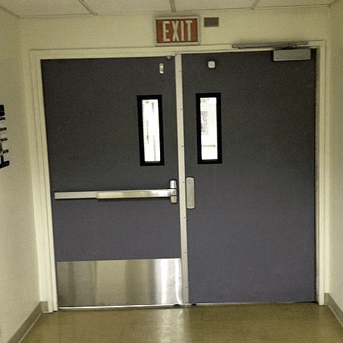
A commercial metal door (commonly of the flush type), is one fabricated of sheet steel and reinforced with metal channels; has a hollow core, sometimes filled with a light filler material.
These types of doors are commonly used as a passive means of protecting people and property from fires in commercial facilities such as schools, industrial plants, hospitals, government facilities and office buildings to name a few.
Advanced Security Safe and Lock provides comprehensive commercial metal door services including but limited to repair, replacement, adjustments, and maintenance. Whether your metal door needs repair itself or it’s the hardware that’s giving you problems we can fix whatever is keeping it from functioning properly. Give us a call now for a free on-site estimate.
Using a hollow metal door has many advantages such as:
Fire retardant
Weather resistant
Durable / great for long term use
Environmentally friendly
Designed to fit nearly every application
Rugged
Less transport cost compared to Wooden doors
Termite/Insect resistant
Low maintenance/repair cost
Fire Rated Doors
Fire Rated Doors are a type of hollow metal door which prevents the spread of fire, smoke, toxic fumes and gases. These doors are a part of an assembly which includes the wall, door and frame specifically manufactured for this purpose. Being Fire Rated typically means the duration for which the door can withstand a standard fire resistance test. We’ve provided a list of UL codes and associated standards:
Other requirements
Uses rated fire door hardware
Steel hinges (to ensure the door will not come loose from the frame and fall out of the opening)
Must be self-closing and self-latching
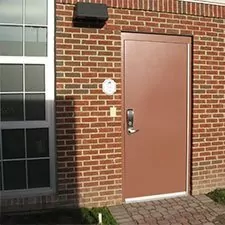
NFPA 80 provides specific guidance on what can and cannot be done to a rated door. When adding a new door or repairing your existing door we ensure that all new components have a label matching the rating of the existing door and frame. We also can provide pre and post repairs to insure that your facility passes its yearly fire inspection.
UL Code
Rating (Resistance Time)
Maximum Glass Area
Use
A*
180 min
100 square inches per leaf Firelite glass only / No dimension to exceed 33”
openings in walls separating buildings that are joined together
B*
90 min
100 square inches per leaf
stairwell doors but are sometimes used at all the rated walls in a building
C*
45 min
1296 square inches per light. No dimension to exceed 54”.
openings from a corridor into another room in the same building
D
90 min
Must check local jurisdiction for standards
exterior doors that are subject to fire hazards from the outside of the door
E
45 min
1296 square inches per light. No dimension to exceed 54”.
exterior doors that are subject to fire hazards from the outside of the door
20 min
1296 square inches per light. No dimension to exceed 54”.
(function( w ){
"use strict";
// rel=preload support test
if( !w.loadCSS ){
w.loadCSS = function(){};
}
// define on the loadCSS obj
var rp = loadCSS.relpreload = {};
// rel=preload feature support test
// runs once and returns a function for compat purposes
rp.support = (function(){
var ret;
try {
ret = w.document.createElement( "link" ).relList.supports( "preload" );
} catch (e) {
ret = false;
}
return function(){
return ret;
};
})();
// if preload isn't supported, get an asynchronous load by using a non-matching media attribute
// then change that media back to its intended value on load
rp.bindMediaToggle = function( link ){
// remember existing media attr for ultimate state, or default to 'all'
var finalMedia = link.media || "all";
function enableStylesheet(){
// unbind listeners
if( link.addEventListener ){
link.removeEventListener( "load", enableStylesheet );
} else if( link.attachEvent ){
link.detachEvent( "onload", enableStylesheet );
}
link.setAttribute( "onload", null );
link.media = finalMedia;
}
// bind load handlers to enable media
if( link.addEventListener ){
link.addEventListener( "load", enableStylesheet );
} else if( link.attachEvent ){
link.attachEvent( "onload", enableStylesheet );
}
// Set rel and non-applicable media type to start an async request
// note: timeout allows this to happen async to let rendering continue in IE
setTimeout(function(){
link.rel = "stylesheet";
link.media = "only x";
});
// also enable media after 3 seconds,
// which will catch very old browsers (android 2.x, old firefox) that don't support onload on link
setTimeout( enableStylesheet, 3000 );
};
// loop through link elements in DOM
rp.poly = function(){
// double check this to prevent external calls from running
if( rp.support() ){
return;
}
var links = w.document.getElementsByTagName( "link" );
for( var i = 0; i < links.length; i++ ){
var link = links[ i ];
// qualify links to those with rel=preload and as=style attrs
if( link.rel === "preload" && link.getAttribute( "as" ) === "style" && !link.getAttribute( "data-loadcss" ) ){
// prevent rerunning on link
link.setAttribute( "data-loadcss", true );
// bind listeners to toggle media back
rp.bindMediaToggle( link );
}
}
};
// if unsupported, run the polyfill
if( !rp.support() ){
// run once at least
rp.poly();
// rerun poly on an interval until onload
var run = w.setInterval( rp.poly, 500 );
if( w.addEventListener ){
w.addEventListener( "load", function(){
rp.poly();
w.clearInterval( run );
} );
} else if( w.attachEvent ){
w.attachEvent( "onload", function(){
rp.poly();
w.clearInterval( run );
} );
}
}
// commonjs
if( typeof exports !== "undefined" ){
exports.loadCSS = loadCSS;
}
else {
w.loadCSS = loadCSS;
}
}( typeof global !== "undefined" ? global : this ) );