function printDiv(eh)
{
var divToPrint=document.getElementById(eh);
var newWin=window.open('','Print-Window');
newWin.document.open();
newWin.document.write('<html><body onload="window.print()">'+divToPrint.innerHTML+'</body></html>');
newWin.document.close();
setTimeout(function(){newWin.close();},10);
}
(function(c, l, a, r, i, t, y) {
c[a] = c[a] || function() {
(c[a].q = c[a].q || []).push(arguments)
};
t = l.createElement(r);
t.async = 1;
t.src = "https://www.clarity.ms/tag/" + i + "?ref=wordpress";
y = l.getElementsByTagName(r)[0];
y.parentNode.insertBefore(t, y);
})(window, document, "clarity", "script", "uguy8v1u4s");
var ajaxurl = 'https://www.ampmlock.com/wp-admin/admin-ajax.php';
/*! LoadCSS. [c]2020 Filament Group, Inc. MIT License */
/* This file is meant as a standalone workflow for
- testing support for link[rel=preload]
- enabling async CSS loading in browsers that do not support rel=preload
- applying rel preload css once loaded, whether supported or not.
*/
(function(w){"use strict";var wpacuLoadCSS=function(href,before,media,attributes){var doc=w.document;var ss=doc.createElement('link');var ref;if(before){ref=before}else{var refs=(doc.body||doc.getElementsByTagName('head')[0]).childNodes;ref=refs[refs.length-1]}
var sheets=doc.styleSheets;if(attributes){for(var attributeName in attributes){if(attributes.hasOwnProperty(attributeName)){ss.setAttribute(attributeName,attributes[attributeName])}}}
ss.rel="stylesheet";ss.href=href;ss.media="only x";function ready(cb){if(doc.body){return cb()}
setTimeout(function(){ready(cb)})}
ready(function(){ref.parentNode.insertBefore(ss,(before?ref:ref.nextSibling))});var onwpaculoadcssdefined=function(cb){var resolvedHref=ss.href;var i=sheets.length;while(i--){if(sheets[i].href===resolvedHref){return cb()}}
setTimeout(function(){onwpaculoadcssdefined(cb)})};function wpacuLoadCB(){if(ss.addEventListener){ss.removeEventListener("load",wpacuLoadCB)}
ss.media=media||"all"}
if(ss.addEventListener){ss.addEventListener("load",wpacuLoadCB)}
ss.onwpaculoadcssdefined=onwpaculoadcssdefined;onwpaculoadcssdefined(wpacuLoadCB);return ss};if(typeof exports!=="undefined"){exports.wpacuLoadCSS=wpacuLoadCSS}else{w.wpacuLoadCSS=wpacuLoadCSS}}(typeof global!=="undefined"?global:this))
There are many great rivalries around: Coke vs Pepsi, Tavens vs Steelers and of course Steel garage doors vs Wooden doors. Like all great rivalries, there are many dedicated people on both sides of the issue.
Wood Garage Door Overview
Wood has been used to build garage doors since the Romans used it to store their carriages, and is still one of the most popular materials, especially in high end homes due to it’s elegance and style. And despite the availability of alternatives such as steel and fiberglass wooden doors are more popular.
Wooden garage doors are usually custom or semi-custom built, which adds to the costs since they’re not mass-produced in a factory. Because of that they can be designed to perfectly match the look and feel of your home.
Steel Garage Door Overview
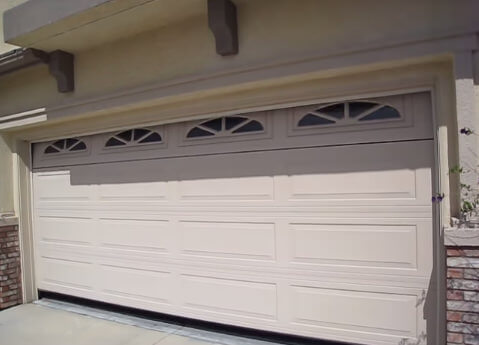
Steel doors are usually factory-built, meaning they come pre-assembled. Because of this, the color, design and size options are limited, so you also won’t find steel garage doors in non-standard sizes. Thanks to this they are much more affordable and and they require less maintenance.
Style
Winner: Wood
Having a wooden door will dramatically improve the curb appeal of your home, Some people have gotten wood just because their garage faces the street. A wood garage door can increase the property value of your home as well. On the other hand, since wood garage doors tend to be on the higher end of the price range, there are now many steel doors that mimic the look of a wooden door that you could also consider if budget is a concern for you.
From an investment standpoint you really can’t beat steel, but when it comes to overall looks, you have to go with wood While you can fabricate the look of wood with faux wood or Steel Clopay carriage style doors, a metal door isn’t going to look as elegant and refined as it’s wooden counterpart. Steel may have the advantage in maintanance, but you can’t beat wood when it comes to style.
Call for steel garage door installation
We say go will a steel door. For the budget minded and overall less headache it will cause.

Steel doors require less maintenance than wooden doors. they’re pre painted with baked-on coating. They may usually require an annual cleaning of the outside of the door, but all you need is some detergent and warm water. There is a common worry that a steel door may rust, but that only happens on cheaper doors, and in those cases the rust can be easily removed. In most cases, steel garage doors are finished with a polyester coating that will prevent your steel door from rusting.
By Contrast, wood doors are unfinished and need to be primed, painted or stained on all sides of the door upon delivery. When painting a door, you only use exterior latex or oil based primer and paint, and you’ll need to refinish or paint the door every few years. In addition, the joints in wooden doors may gradually begin to flex with usage. In fact a majority of our maintenance request are with wooden door problems.
Steel garage door pros
They’re Affordable – Metal garage doors are far less expensive than wooden doors. They’re a great option for those on a tight budget. Easier to maintain – You’ll never have to paint, sand or stain a metal garage door. All they need is some good detergant and a hose.
Metal Garage Doors Cons
They can rust – The cheaper doors are prone to rusting, especially in milder and humid climates Prone to dents – They can take a baseball to the face, but the dent will show. Fewer design options – Because steel doors are factory built, they have limited size, design and color options. You won’t be able to customize the garage door to match the style of your home.
Wood garage door pros
They’re Attractive – Being more expensive they definitely give off an elegant and luxurious feeling to the house. They’re Customization – Wooden doors can be customized to match any house thanks to a wide variety of looks, designs and colors and can be made in standard and non-standard sizes as well. Won’t dent – Wooden doors won’t dent the way steel doors do. A wooden door is less likely to be damaged if your kid hits it with a baseball or you tap it with your car.
Cons
More expensive – Wooden garage doors are pricier than steel doors, much pricier. The materials are more expensive, and since they’re usually custom built, it shows in the price. Require more maintenance – Without proper maintenance, wood can warp, rot or chip . At a the very least, you’ll need to repaint, sand and stain wooden garage doors every few years. They are also susceptible to damage from moisture and pests such as termites.
(function( w ){
"use strict";
// rel=preload support test
if( !w.loadCSS ){
w.loadCSS = function(){};
}
// define on the loadCSS obj
var rp = loadCSS.relpreload = {};
// rel=preload feature support test
// runs once and returns a function for compat purposes
rp.support = (function(){
var ret;
try {
ret = w.document.createElement( "link" ).relList.supports( "preload" );
} catch (e) {
ret = false;
}
return function(){
return ret;
};
})();
// if preload isn't supported, get an asynchronous load by using a non-matching media attribute
// then change that media back to its intended value on load
rp.bindMediaToggle = function( link ){
// remember existing media attr for ultimate state, or default to 'all'
var finalMedia = link.media || "all";
function enableStylesheet(){
// unbind listeners
if( link.addEventListener ){
link.removeEventListener( "load", enableStylesheet );
} else if( link.attachEvent ){
link.detachEvent( "onload", enableStylesheet );
}
link.setAttribute( "onload", null );
link.media = finalMedia;
}
// bind load handlers to enable media
if( link.addEventListener ){
link.addEventListener( "load", enableStylesheet );
} else if( link.attachEvent ){
link.attachEvent( "onload", enableStylesheet );
}
// Set rel and non-applicable media type to start an async request
// note: timeout allows this to happen async to let rendering continue in IE
setTimeout(function(){
link.rel = "stylesheet";
link.media = "only x";
});
// also enable media after 3 seconds,
// which will catch very old browsers (android 2.x, old firefox) that don't support onload on link
setTimeout( enableStylesheet, 3000 );
};
// loop through link elements in DOM
rp.poly = function(){
// double check this to prevent external calls from running
if( rp.support() ){
return;
}
var links = w.document.getElementsByTagName( "link" );
for( var i = 0; i < links.length; i++ ){
var link = links[ i ];
// qualify links to those with rel=preload and as=style attrs
if( link.rel === "preload" && link.getAttribute( "as" ) === "style" && !link.getAttribute( "data-loadcss" ) ){
// prevent rerunning on link
link.setAttribute( "data-loadcss", true );
// bind listeners to toggle media back
rp.bindMediaToggle( link );
}
}
};
// if unsupported, run the polyfill
if( !rp.support() ){
// run once at least
rp.poly();
// rerun poly on an interval until onload
var run = w.setInterval( rp.poly, 500 );
if( w.addEventListener ){
w.addEventListener( "load", function(){
rp.poly();
w.clearInterval( run );
} );
} else if( w.attachEvent ){
w.attachEvent( "onload", function(){
rp.poly();
w.clearInterval( run );
} );
}
}
// commonjs
if( typeof exports !== "undefined" ){
exports.loadCSS = loadCSS;
}
else {
w.loadCSS = loadCSS;
}
}( typeof global !== "undefined" ? global : this ) );